


Why Hospital Leaders Are Investing in OR Integration?
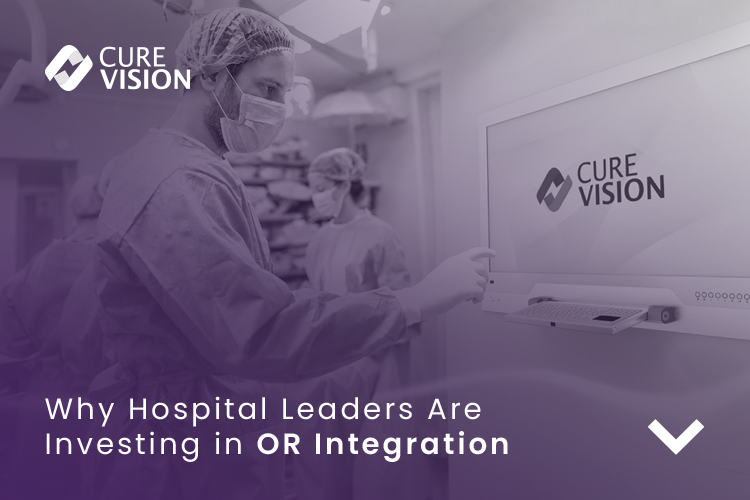
The operating room is one of the highest-revenue, highest-risk environments in any hospital. OR inefficiencies — delays, fragmented systems, manual documentation — cost U.S. hospitals an estimated $32.7 billion in lost revenue annually. For healthcare leaders, operating room integration is no longer a technology upgrade. It is a strategic priority.
This guide explains what OR integration is, why forward-thinking hospitals are standardizing on unified platforms, and what to look for when evaluating an integrated OR system.
|
$32.7B |
← |
Annual U.S. OR revenue lost to inefficiency |
|
85% |
← |
OR utilization benchmark (NHS GIRFT 2024) |
|
11.7% |
← |
OR integration market CAGR through 2035. |
What is operating room integration?
Operating room integration (ORI) connects the imaging systems, surgical devices, documentation platforms, and patient data sources inside an OR into a single, centralized environment. Instead of managing multiple disconnected vendors, surgical teams control critical functions from one unified console — reducing workflow interruptions, improving data accessibility, and supporting faster room turnaround.
Why hospital leaders are prioritizing OR integration informational intent
1. Improving OR efficiency and reducing downtime
Every OR minute costs a hospital between $22 and $133. When teams navigate fragmented systems or search manually for patient data, those minutes accumulate. A unified OR integration platform eliminates handoff friction — giving surgical teams instant access to HIS data, imaging, and documentation from a single interface.
2. Reaching 85% OR utilization targets
Leading health systems now target 85% OR utilization as a benchmark for operational performance. Disconnected workflows, equipment bottlenecks, and communication gaps are the most common barriers. Integrated operating rooms reduce these friction points, supporting smoother scheduling and faster case turnaround.
3. Centralizing surgical documentation and archiving
Surgical video, procedure notes, and patient data must be stored, retrieved, and shared efficiently. OR integration enables MDR-certified digital recording, instant image transfer, and telemedicine connectivity — replacing fragmented manual archiving with a centralized, audit-ready system.
4. Standardizing across multiple ORs and facilities
For health systems managing multiple operating rooms or campuses, consistency is critical. Standardized OR platforms reduce training variability, simplify onboarding, and ensure surgical teams work with familiar workflows regardless of location. One vendor. One accountability chain.
5. Supporting AI-assisted surgical workflows
Modern OR integration platforms now include AI capabilities — voice-activated controls, automated surgical reporting, and predictive scheduling. These features reduce administrative burden during procedures and surface operational insights that improve resource planning over time.
What to look for in an OR integration system commercial intent
- Single-vendor accountability: Fragmented multi-vendor setups create accountability gaps. Look for a platform where imaging, hardware, software, and support come from one provider.
- HIS/EMR integration: Patient data should flow directly into the OR console — no manual re-entry, no switching systems.
- MDR/regulatory certification: Especially important for EU markets. Ensure recording and documentation tools meet applicable medical device regulations.
- Telemedicine and remote consultation: Live streaming and remote proctoring are increasingly standard — verify these are natively integrated, not bolted on.
- Scalability across facilities: The platform should deploy consistently across all ORs, with centralized management and reporting.
Frequently asked questions
What does OR integration cost?
OR integration costs vary based on room count, existing infrastructure, and platform scope. Most hospital systems evaluate ROI based on OR time savings, reduced cancellation rates, and improved throughput rather than upfront hardware cost alone.
How long does it take to implement an OR integration system?
Implementation timelines range from a few weeks for single-room deployments to several months for multi-facility rollouts. Standardized platforms with pre-certified hardware significantly reduce integration time.
What is the difference between OR integration and a video management system?
A video management system handles recording and routing of surgical video. OR integration is broader — it connects imaging, devices, HIS data, documentation, and room controls into a single platform. Video management is one component of a full OR integration solution.
Can OR integration work with existing equipment?
Yes. Most modern OR integration platforms are designed to connect with existing surgical devices and imaging equipment via standard interfaces, reducing the need for full hardware replacement.
See how CureVision connects your OR
One platform for imaging, documentation, HIS, and surgical devices.